GoHighLevel vs HubSpot, in one line: GoHighLevel is the better pick for local service businesses and agencies that want texting, calls, booking, funnels and automation in one flat-priced account. HubSpot is the better pick for B2B teams with longer sales cycles that need clean reporting and a CRM that scales with a growing sales team. I set up both for clients every week, and that is the split I keep coming back to.
I’m Mostafa, a WordPress, CRM and AI automation developer. I end up inside GoHighLevel and HubSpot accounts almost every day. Some I build from scratch. Others I’m asked to clean up after someone picked the wrong tool for the job.
That second group is why I wrote this GoHighLevel vs HubSpot comparison. The question is rarely “which CRM is better?” It’s “which one fits the way this business actually gets and follows up with leads?” Below is how the two compare on price, features and day-to-day use, and the simple rules I use to recommend one over the other.
Table of Contents
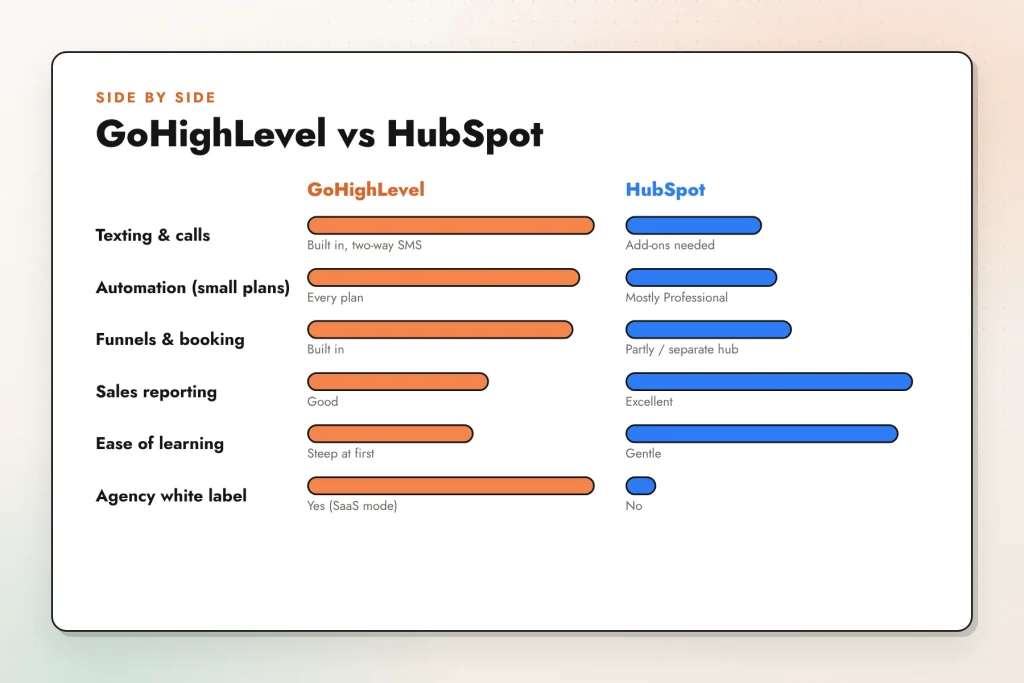
GoHighLevel vs HubSpot at a glance
| GoHighLevel | HubSpot | |
|---|---|---|
| Best for | Local service businesses, coaches, marketing agencies | B2B companies, SaaS, consulting firms, growing sales teams |
| Pricing model | Flat monthly fee per account, plus usage (SMS, calls, email) | Per seat, plus marketing contacts on paid tiers |
| Starting price | About $97/month (Starter) | Free CRM; paid Starter from about $15-20 per seat/month |
| Texting and calls | Built in (two-way SMS, calls, missed-call text back) | Calling built in; SMS mostly through add-ons or integrations |
| Funnels and websites | Built in (funnels, websites, forms, calendars) | Landing pages and CMS; full website builder is a separate hub |
| Automation | Strong workflows on every plan | Simple automation on Starter; full workflows from Professional |
| Reporting | Good for leads and appointments | Excellent, especially for sales pipelines and attribution |
| Learning curve | Steep at first, a lot in one place | Gentler, very polished interface |
| White label for agencies | Yes (SaaS mode on the Agency Pro plan) | No |
What GoHighLevel actually is
GoHighLevel (most people just call it GHL) is an all-in-one sales and marketing platform built originally for marketing agencies. One account gives you a CRM, pipelines, two-way SMS and email, phone numbers, booking calendars, funnels and websites, forms, reputation management, and a workflow builder that ties all of it together.
You’ll also see it written as Go High Level or simply HighLevel. It’s the same product, and “GHL” is the short name everyone in the community uses.
Its real strength is speed of follow-up. A lead fills in a form, gets a text within seconds, gets a reminder before the appointment, and gets a review request after the job, all without anyone on the team lifting a finger. I wrote about the exact GoHighLevel automation workflows I set up first for almost every account.
The trade-off is that GHL tries to do everything, and not every part is equally polished. The email builder and reporting are fine, not great. The interface changes often. And because it’s so flexible, a badly built account gets messy fast.
What HubSpot actually is
HubSpot is a CRM platform split into “hubs”: Marketing, Sales, Service, Content and a few others, all sharing one contact database. The free CRM is genuinely useful on its own, which is why so many small teams start there.
HubSpot shines when a sale involves several conversations, several people and a few weeks of back-and-forth. Deal stages, tasks, sequences, email tracking and reporting are all excellent, and the interface is clean enough that sales teams actually use it. It also connects well with WordPress; here’s my guide to connecting HubSpot to WordPress.
The trade-off is cost as you grow. The serious automation and reporting live in the Professional tiers, which are priced per seat and come with onboarding fees. For a five-person team that adds up quickly.
GoHighLevel vs HubSpot pricing in 2026
GoHighLevel vs HubSpot pricing is harder to compare than it looks, because one charges per account and the other per seat. Both companies also change prices and plan names regularly, so treat these as ballpark figures and check the official GoHighLevel pricing page and HubSpot pricing page before you buy.
| Plan | Price (approx., per month) | What stands out |
|---|---|---|
| GoHighLevel Starter | $97 | Up to 3 sub-accounts; core CRM, funnels, SMS, calendars, workflows |
| GoHighLevel Unlimited | $297 | Unlimited sub-accounts; API access |
| GoHighLevel Agency Pro | $497 | SaaS mode: resell GHL under your own brand |
| HubSpot Free CRM | $0 | Up to 2 users and limited contacts on newer accounts |
| HubSpot Starter | About $15-20 per seat | Forms, email marketing, simple automation |
| HubSpot Sales Hub Professional | About $100 per seat (annual) | Sequences, forecasting, workflows; onboarding fee around $1,500 |
| HubSpot Marketing Hub Professional | About $890 (3 seats included) | Full marketing automation; onboarding fee around $3,000 |
Two things catch people out:
- GoHighLevel’s usage costs. Texts, calls, emails and AI features are paid from a wallet on top of the plan. For a busy local business that’s often $20-$100 a month extra. US texting also needs A2P 10DLC registration before carriers will deliver your messages reliably.
- HubSpot’s jump to Professional. Starter is cheap, but the moment you need real multi-step workflows, you’re looking at Professional pricing plus a one-time onboarding fee. Budget for that from day one, not after you’ve built everything on Starter.
In practice, on price alone the GoHighLevel vs HubSpot question has a simple answer: for a small team that needs automation, GoHighLevel is usually the cheaper of the two. For a solo founder who mostly needs a tidy contact list and a deal pipeline, HubSpot’s free CRM costs nothing at all.
GoHighLevel vs HubSpot features in daily use
CRM and pipelines
Both handle contacts, companies and deal pipelines well. HubSpot is cleaner: properties, associations between contacts, companies and deals, and activity timelines are some of the best I’ve used. GoHighLevel’s CRM is more basic but perfectly fine for a business that sells a service in one or two conversations.
Automation and workflows
For most small businesses, automation is where the GoHighLevel vs HubSpot gap is biggest, and this is where GoHighLevel pulls ahead. Every plan includes a visual workflow builder with triggers for form fills, missed calls, appointment changes, pipeline moves and replies. HubSpot’s workflow tool is excellent too, but most of its power sits behind the Professional tiers.
Texting, calls and missed-call text back
GoHighLevel was built around two-way SMS, and it shows. Missed-call text back alone wins a lot of local businesses over, because a caller who hits voicemail usually just calls the next company on the list. HubSpot has calling and a good inbox, but SMS typically means an integration or a third-party app.
Websites, funnels and booking
GoHighLevel includes a funnel builder, a website builder, forms, surveys and calendars. They’re not as flexible as a proper WordPress site, which is why many of my clients keep WordPress for the main website and use GHL for funnels and booking. HubSpot offers landing pages and a solid CMS, but its full website platform is a separate, paid hub.
Email marketing
HubSpot’s email tools are more polished: better templates, better personalization and better deliverability reporting. GoHighLevel’s email works and is cheap to send, but you’ll spend more time getting campaigns to look right.
Reporting
HubSpot wins the GoHighLevel vs HubSpot reporting match-up clearly. If your sales manager wants to know which campaign produced which deal and how long each stage takes, HubSpot answers that out of the box. GoHighLevel’s reporting covers leads, appointments and conversions well enough for most local businesses, but tracking paid ad attribution properly takes extra setup.
Integrations and WordPress
HubSpot has one of the largest app marketplaces in the industry and an official WordPress plugin. GoHighLevel integrates through its marketplace, webhooks, Zapier and its API. Connecting a WordPress site to either is something I do often: forms, chat widgets and tracking are all straightforward when they’re set up carefully.
Mobile apps
Both have solid mobile apps, and for many small businesses the app matters more than the desktop version. GoHighLevel’s app (branded as LeadConnector, or your own brand on SaaS mode) is built around the conversations inbox: reply to texts, answer calls and check the calendar from your phone. HubSpot’s app is stronger for sales reps on the road, with deal updates, call logging and business card scanning.
Contracts and data ownership
GoHighLevel is month to month with no onboarding fee, so it’s easy to try and easy to leave. HubSpot’s Starter plans are also monthly, but Professional and Enterprise plans usually need an annual commitment. With either one, you can export your contacts, companies and deals at any time, so you’re never locked in to your data.
Ease of use
Ease of use is GoHighLevel’s softest spot in any GoHighLevel vs HubSpot comparison. HubSpot is easier to learn. GoHighLevel has a steeper learning curve because so much lives in one place. Once a GHL account is built well, though, the team mostly lives in the Conversations inbox and the calendar, and that part is simple.
GoHighLevel vs HubSpot: which one for your business?
- Local service businesses (home services, clinics, salons, contractors): GoHighLevel. Fast replies, missed-call text back, booking and review requests matter more than deep reporting.
- Marketing agencies: GoHighLevel, especially if you want to resell it under your own brand with snapshots and SaaS mode.
- B2B companies and SaaS: HubSpot. Longer sales cycles, several decision-makers and the need for clean reporting suit it perfectly.
- Consultants and professional services: usually HubSpot. Deals, proposals and follow-up tasks work beautifully there.
- Coaches and course creators: GoHighLevel, if you want funnels, memberships, booking and email in one bill.
- E-commerce stores: often neither as the main tool. Shopify or WooCommerce with a dedicated email platform tends to fit better, with HubSpot as the CRM if you sell B2B.
GoHighLevel vs HubSpot for marketing agencies
Agencies are the one group where the GoHighLevel vs HubSpot decision is usually quick. GoHighLevel was designed for agencies: you get one agency account, a sub-account for each client, and snapshots that let you copy a finished setup (pipelines, workflows, calendars, funnels) into a new client account in minutes. On the Agency Pro plan, SaaS mode lets you rebrand the whole platform and bill clients for it directly.
HubSpot works differently. Each client normally has their own HubSpot portal and pays HubSpot directly, and your agency is a partner that manages it. That’s a cleaner relationship for bigger B2B clients, but it gives you no way to package the software into your own monthly retainer.
In the agency accounts I work in, the pattern is simple: GoHighLevel for local-business clients where speed of follow-up matters, HubSpot for the occasional larger B2B client who already uses it. Trying to force every client into one tool tends to backfire.
Support, reliability and how often things change
On support, the GoHighLevel vs HubSpot difference mostly comes down to how fast each platform changes. HubSpot is the steadier one. Features change slowly, documentation is thorough, and the HubSpot Academy courses are genuinely good for training a team. Paid plans come with chat and phone support that’s usually quick.
GoHighLevel moves much faster. New features ship almost every week, which is exciting, but it also means menus move, workflow actions get renamed and the occasional update breaks something that worked yesterday. Support is available around the clock by chat and through a very active community, though answers can depend on who you reach.
None of this is a deal-breaker for either one. It just means a GoHighLevel account benefits from someone who checks it regularly, while a HubSpot account can run for months with less attention.
Can you use GoHighLevel and HubSpot together?
Sometimes the honest answer to GoHighLevel vs HubSpot is “both”. You can run them together, and I’ve seen it work, but only when each tool has one clear job. The most common setup is HubSpot as the system of record for the sales team, with GoHighLevel handling texting, missed-call text back and appointment reminders, synced through webhooks or Zapier.
My honest advice: avoid it unless there’s a strong reason. Two CRMs means two places where contact data can drift apart, and somebody has to own keeping them in sync. For most small businesses, picking one and setting it up properly is the better move.
Mistakes I see when businesses switch
Whichever side of the GoHighLevel vs HubSpot decision you land on, these are the mistakes that cost the most time later:
- Moving messy data. Importing years of duplicates and dead contacts into a new CRM just moves the mess. Clean first, then migrate.
- Copying old workflows one-for-one. A new platform is a chance to simplify. Most accounts need five good automations, not thirty half-working ones.
- Skipping texting compliance. In the US, SMS without A2P 10DLC registration gets filtered. Start the registration first; it can take days.
- Forgetting the website. Forms on WordPress need to send leads into the new CRM, with tracking intact. This is the step most often missed.
- No owner. Every CRM decays without someone responsible for it. Decide who that is before launch.
How to decide in 10 minutes
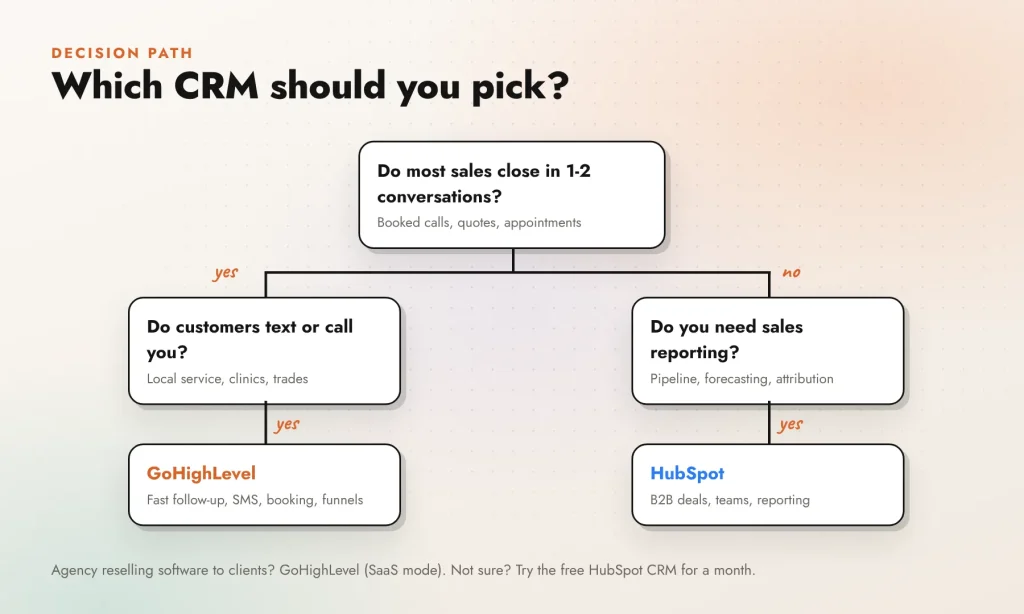
This is the short GoHighLevel vs HubSpot test I run with new clients. Answer these five questions honestly:
- Do most of your sales close in one or two conversations? If yes, lean GoHighLevel.
- Is texting customers a big part of how you work? If yes, lean GoHighLevel.
- Do you have a sales team that needs forecasting and detailed reporting? If yes, lean HubSpot.
- Do you sell to other businesses with multiple decision-makers? If yes, lean HubSpot.
- Are you an agency that wants to resell software to clients? If yes, GoHighLevel.
Most businesses answer three or four of these the same way, and that settles it. The GoHighLevel vs HubSpot debate online makes it sound closer than it usually is for a specific business.
If your answers split down the middle, start with the HubSpot free CRM for a month. It costs nothing, and you’ll quickly learn whether you miss texting and automation, which is the clearest sign GoHighLevel is the better home.
My take after building in both
If you forced me to give one rule, it would be this: choose the tool that matches how your customers want to talk to you. If they text, call and book appointments, GoHighLevel will feel like it was made for you. If they email, sit in meetings and compare proposals for weeks, HubSpot will.
Either way, the platform matters less than the setup. I’ve seen excellent results on both and terrible accounts on both. A clean pipeline, five automations that actually fire, forms on your website that land in the right place, and one person who owns the system will beat any feature list.
Frequently asked questions
What is the main difference in GoHighLevel vs HubSpot?
The main GoHighLevel vs HubSpot difference is focus. GoHighLevel is an all-in-one platform built around fast lead follow-up: texting, calls, booking, funnels and automation for a flat monthly price. HubSpot is a CRM platform built around the sales process: deals, teams and detailed reporting, priced per seat.
Is GoHighLevel cheaper than HubSpot?
Usually, for small teams that need automation. GoHighLevel starts at about $97 a month with workflows included, plus usage costs for texts and calls. HubSpot’s free CRM costs nothing, but full workflow automation starts in the Professional tiers, which are priced per seat and include onboarding fees.
Can GoHighLevel replace HubSpot?
For local service businesses and agencies, yes: it covers CRM, pipelines, texting, email, booking, funnels and automation. For B2B teams that rely on detailed sales reporting and forecasting, HubSpot is still stronger.
Which is easier to learn, GoHighLevel or HubSpot?
HubSpot. Its interface is more polished and better organized. GoHighLevel has a steeper learning curve because so many tools live in one account, though day-to-day use becomes simple once it’s set up well.
Does GoHighLevel work with WordPress?
Yes. You can embed GoHighLevel forms, calendars and chat widgets on a WordPress site, or send existing WordPress form submissions into GoHighLevel by webhook while keeping UTM tracking on each contact.
Can I move from HubSpot to GoHighLevel, or the other way around?
Yes. Contacts, companies and deals can be exported and imported between the two. The work is in cleaning the data first and rebuilding automations properly rather than copying them one-for-one.
Need help setting up either one?
If you’re still stuck on GoHighLevel vs HubSpot, that’s normal. I build and fix both platforms for clients, and I’m happy to tell you honestly which one fits your business before you spend anything. See what I offer as a GoHighLevel expert or for HubSpot implementation, or send me a message with a few lines about how leads reach you today.